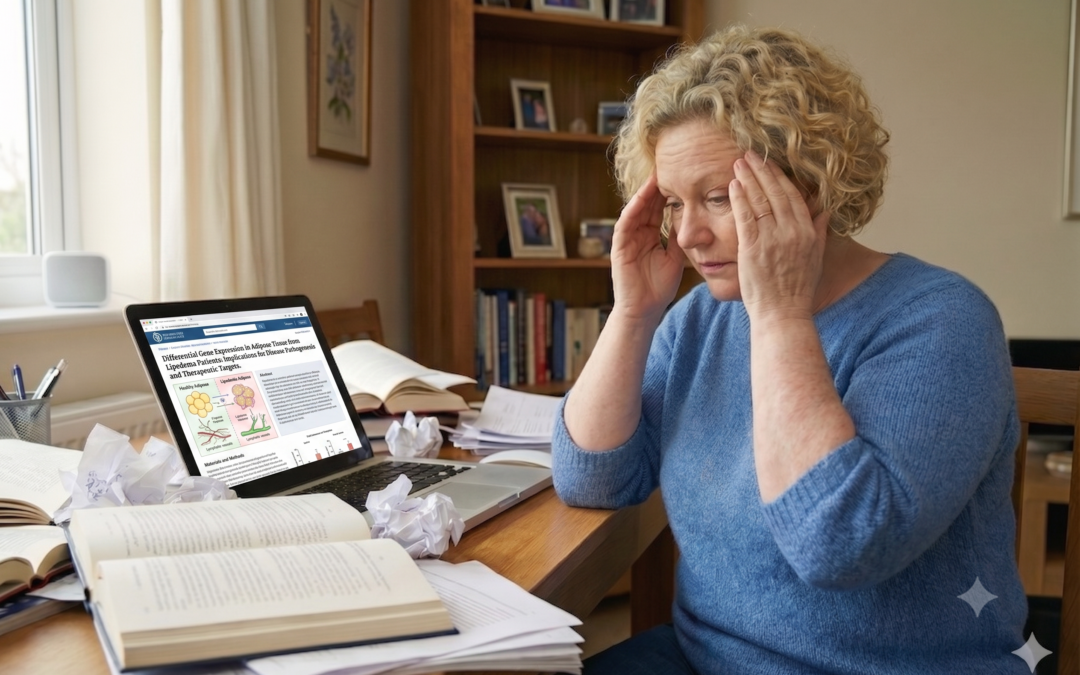
If you’ve been diagnosed with lipedema—or even suspect you might have it—your first instinct is completely understandable. You go to the internet. You start Googling symptoms, scrolling social media, joining Facebook groups, watching TikToks, and reading blogs late into the night. Information feels like power, especially after doctors have dismissed you, minimized your pain, or told you to “just lose weight.”
That instinct isn’t wrong. Wanting answers is healthy. Wanting to understand your own body is exactly what you should be doing.
But here’s the uncomfortable truth: the internet is one of the most confusing—and sometimes risky—places to actually research lipedema. Not because women are doing anything wrong, and not because you’re “bad at research.” It’s because the system is stacked against clear, accurate, and unbiased information.
The good news, and we want to say this clearly and early: you don’t have to figure this out alone, and real help exists. Once you understand why the internet feels so overwhelming, it gets a lot easier to use it well—and to recognize when it’s time to bring in someone who works with these cases every day.
Let’s talk about why.
1. The Internet Doesn’t Distinguish Between Experience and Expertise
One of the most powerful—and most dangerous—things about online lipedema spaces is that personal stories often carry more weight than medical or insurance facts.
A woman sharing her journey may be sincere, emotional, and deeply convincing. Her story may also be genuinely helpful. But it’s worth remembering:
- One person’s outcome is not evidence.
- Anecdotes are not the same as data.
- What worked for someone else may be unsafe, ineffective, or simply irrelevant to your situation.
Online platforms tend to reward emotion and certainty, not nuance. The most confident voice often rises to the top—even when it’s incomplete or wrong. That’s not a knock on the women sharing; it’s just how these spaces are built.
2. Social Media Algorithms Reward Extremes, Not Accuracy
Facebook, Instagram, TikTok, Reddit, and YouTube are not neutral libraries. They are engagement machines, designed to keep you watching.
That means:
- Outrage spreads faster than balance.
- Fear gets more clicks than caution.
- Absolute claims outperform honest uncertainty.
Content like “Doctors don’t want you to know this” or “Insurance will NEVER cover lipedema surgery” gets pushed harder than content that says, “It depends on your specific policy, your documentation, and your surgeon.”
The second version is the truthful one. But it’s calmer, more conditional, and less shareable—so the algorithm buries it. Lipedema is complicated, and algorithms don’t like complicated.
3. Short-Form Video (Especially TikTok) Adds a New Layer of Risk
TikTok deserves its own mention, because it has quickly become one of the biggest places women first learn the word “lipedema”—and one of the trickiest to navigate.
Short-form video is built for speed and emotion. In sixty seconds, a charismatic creator can deliver a diagnosis, a “cause,” a treatment, and an insurance verdict—all with total confidence and zero context. The format rewards a good hook, a dramatic before-and-after, and a tidy conclusion. It does not reward the boring but essential caveats that make medical and insurance information actually accurate.
A few things worth keeping in mind about TikTok specifically:
- Confidence is the product. A creator who says “Here’s the exact code that gets you approved” will outperform one who says “Coverage depends on your plan”—even though the second is correct.
- Trends flatten nuance. A single viral video can convince thousands of women that one path, one surgeon, or one insurer’s behavior is universal, when the reality is highly individual.
- You rarely see who’s behind the account. Sponsorships, referral arrangements, and business relationships are easy to leave out of a fast-moving clip.
- Comments feel like consensus. Hundreds of “same!” replies can make a shaky claim feel settled, even when it isn’t.
TikTok can be a wonderful place to feel less alone and to realize lipedema is real. Just treat what you see there as a starting point for questions—not as a finished answer about your body or your coverage.
4. Some “Educational” Voices Have Financial Incentives
This is one of the harder truths to sit with.
A meaningful share of lipedema-related content online comes from people or businesses that have something to sell or gain. Depending on the source, that can include:
- Earning referral fees.
- Selling courses, coaching, or “coverage help.”
- Working directly or indirectly with specific surgical practices.
- Benefiting when you believe insurance can’t or won’t help you.
This doesn’t mean the information is always wrong, or that everyone with a financial interest is acting in bad faith—plenty aren’t. But it does mean some content may be incomplete, slanted, or quietly designed to steer you toward one specific (and often expensive) path.
The tell is usually what’s missing: transparency is rare, disclaimers are vague, and conflicts of interest often go unstated. When something feels like it’s nudging you toward a single answer, it’s fair to ask, “Who benefits if I believe this?”
5. Medical and Insurance Information Goes Out of Date—Fast
Lipedema coverage policies, diagnostic criteria, and surgical standards are evolving quickly.
What you read in:
- A Facebook post from 2022,
- A blog written before recent lawsuits and settlements, or
- A comment from someone approved under a completely different plan,
…may simply no longer apply.
The problem is that old information lives forever online. A viral post from three years ago can still be the first thing you find—and there’s no expiration date stamped on it. Coverage that was impossible under one policy last year may be attainable under yours today, and vice versa.
6. Online Groups Often Confuse Support With Authority
Support groups are genuinely valuable. Feeling seen, believed, and understood matters enormously—especially after being dismissed by the medical system. We never want to talk anyone out of finding their community.
But support and authority aren’t the same thing, and many groups unintentionally blur the line. Over time, some become places where:
- Opinions get treated as facts.
- Dissent is shut down.
- Reasonable questions get labeled as “negativity” or “fear-based.”
- Complex insurance realities are flattened into simple slogans.
When moderation is thin—or leans one way—misinformation can spread unchecked, and the women asking the most sensible questions are sometimes the ones told to be quiet.
Lean on your groups for connection and encouragement. Just be cautious about treating them as your source of truth on coverage and surgery.
7. Insurance and Surgery Are Deeply Individual
This may be the single biggest problem with researching lipedema online: coverage is not one-size-fits-all.
Your outcome depends on things a viral post can’t possibly know:
- Your specific insurance plan—not just the insurer’s name on the card.
- Whether your surgeon is in-network or out-of-network.
- Your documentation, coding, and medical-necessity language.
- State laws, employer plan design, and appeals strategy.
Advice that ignores these variables—no matter how confident it sounds—can leave you misinformed, discouraged, or financially harmed. Two women with the same diagnosis and the same insurer can have completely different results, simply because their plans and paperwork are different.
So What Should You Use the Internet For?
The internet isn’t the enemy. Used the right way, it’s a genuinely helpful tool.
It’s great for:
- Learning basic terminology and understanding your body.
- Realizing that lipedema is real, common, and not your fault.
- Finding community and emotional support.
- Generating good questions to bring to qualified experts.
It’s simply not a substitute for:
- An individualized analysis of your insurance plan.
- Evidence-based surgical guidance.
- Up-to-date policy interpretation.
- Professionals who work directly with payers and providers.
Think of the internet as the place you gather questions—not the place you get your final answers.
You Don’t Have to Navigate This Alone
Here’s what we most want you to take away: the confusion you feel online isn’t a reflection of you. It’s a reflection of an ecosystem that rewards certainty over truth, profit over clarity, and volume over accuracy. Anyone would feel overwhelmed trying to piece together something this personal from a feed built to keep them scrolling.
But overwhelmed is not the same as stuck.
There are people whose entire job is to do this work—reading the actual policy language, assembling the documentation, understanding how a specific plan handles lipedema, and building a real coverage strategy around your situation instead of a stranger’s viral post. That kind of individualized help exists, and it’s exactly the piece the internet can’t give you.
So keep learning. Keep leaning on your community. Keep asking questions. Just know that when you’re ready to move from researching to actually pursuing coverage, you don’t have to hold all of it by yourself. The path forward is clearer than the internet makes it look—and there are people ready to walk it with you.
The Bottom Line
Women with lipedema are not “bad at research.” They’re navigating a condition that has been ignored, minimized, and monetized—often all at once.
The problem was never your curiosity. The problem is an online world that rewards confidence over accuracy. And the solution isn’t to stop learning—it’s to pair what you learn with real, individualized, up-to-date help.
That help is available. And you deserve it.